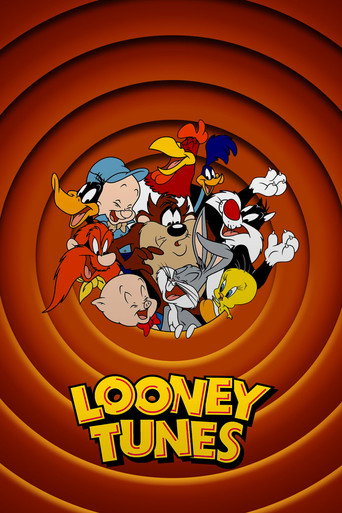
Looney Tunes and Merrie Melodies
Series, 1930, The golden age, Set in The theatrical shorts, 1930 to 1969
Looney Tunes and Merrie Melodies is #1 of 18 in release order and #1 of 18 in chronological order in the Looney Tunes.
The story
Series of comedy short films from 1929 to 1969 during the golden age of American animation, alongside its sister series Merrie Melodies.
Looney Tunes and Merrie Melodies recap
The theatrical cartoons Warner Bros. released before features from 1930 to 1969, under two series names, Looney Tunes and Merrie Melodies. The early shorts, made for producer Leon Schlesinger, starred Bosko, while the Merrie Melodies were built around popular songs. The studio found its voice in the mid-1930s, when directors Tex Avery, Frank Tashlin, Bob Clampett and Chuck Jones, working in a run-down building nicknamed Termite Terrace, pushed the gags faster and stranger. Porky Pig arrived in 1935, Daffy Duck in 1937 and Bugs Bunny in A Wild Hare (1940), facing the hunter Elmer Fudd and asking "What's up, Doc?". Mel Blanc voiced nearly all of them, and Carl Stalling scored them. Through the 1940s and 1950s the cast grew: Tweety and Sylvester, Yosemite Sam, Foghorn Leghorn, Pepe Le Pew, Marvin the Martian, Speedy Gonzales, the Tasmanian Devil, and Wile E. Coyote and the Road Runner. Friz Freleng, Robert McKimson and Chuck Jones led the postwar units. Famous shorts include Jones's Duck Amuck (1953), where an unseen animator torments Daffy, the Bugs, Daffy and Elmer hunting trilogy, One Froggy Evening (1955) and What's Opera, Doc? (1957), in which Elmer hunts Bugs through a Wagner opera. Several won Academy Awards, including Tweetie Pie (1947), Speedy Gonzales (1955) and Knighty Knight Bugs (1958).
Looney Tunes and Merrie Melodies ending explained
The classic shorts ended without a finale. Warner Bros. closed its cartoon studio in 1963, outsourced new shorts to DePatie-Freleng Enterprises, then reopened a smaller studio, and the last of the original run, Robert McKimson's Injun Trouble, was released in 1969. By then the shorts had found a second life on television, starting with The Bugs Bunny Show in 1960, and they were repackaged for decades, including in The Bugs Bunny/Road Runner Hour.
Where it fits
- Release order: first, before The Bugs Bunny/Road Runner Hour.
- Chronological order: first, before The Bugs Bunny/Road Runner Hour.
What to watch before Looney Tunes and Merrie Melodies
Nothing. Looney Tunes and Merrie Melodies is the first of the Looney Tunes essentials, so it's the place to start.
Cast
- June Foray as Granny, Witch Hazel, various others
- Arthur Q. Bryan as Elmer Fudd
- Billy Bletcher as Papa Bear, Spike, Wolf, various others
- Mel Blanc as Bugs Bunny, Daffy Duck, Tweety, Sylvester the Cat, Yosemite Sam, various others
Created by Leon Schlesinger.